


Blue Array’s Guide to Crafting Content for Humans, Search Engines and LLMs
In the era of AI-powered platforms such as ChatGPT, Gemini, and other Large Language Models (LLMs), Blue Array recognises the need for a transformative approach to content creation.
As LLMs become pivotal in guiding brand recommendations and product discovery, our strategies must evolve to ensure content is both discoverable and influential in AI-driven ecosystems.
This guide outlines Blue Array’s proprietary approach to creating content optimised for LLMs, blending traditional SEO principles with advanced techniques to enhance comprehension and retention by AI models.
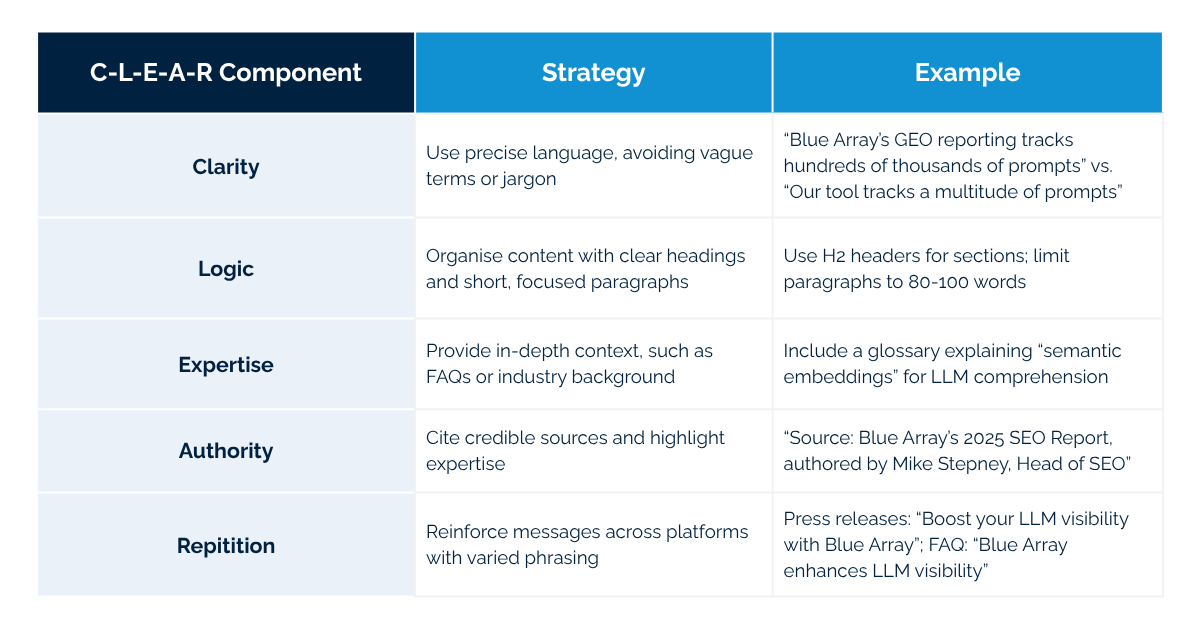
Our framework, C-L-E-A-R (Clarity, Logic, Expertise, Authority, Repetition), ensures content is structured, meaningful, and credible, positioning your brand as a trusted authority in AI-generated outputs.
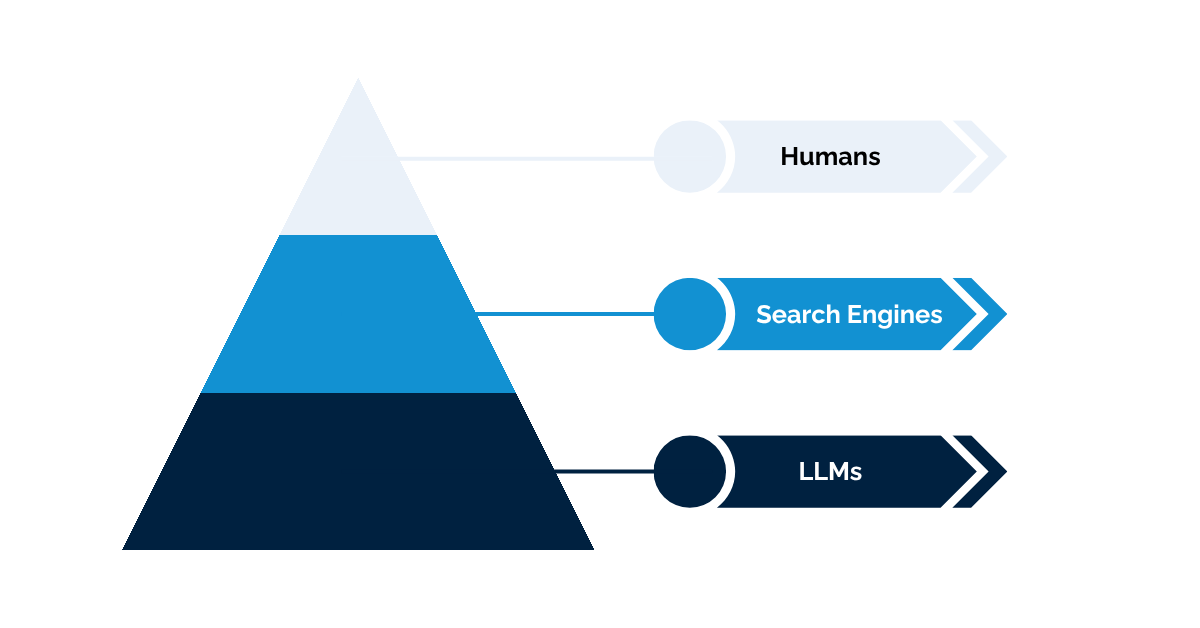
Understanding LLMs vs. Traditional SEO
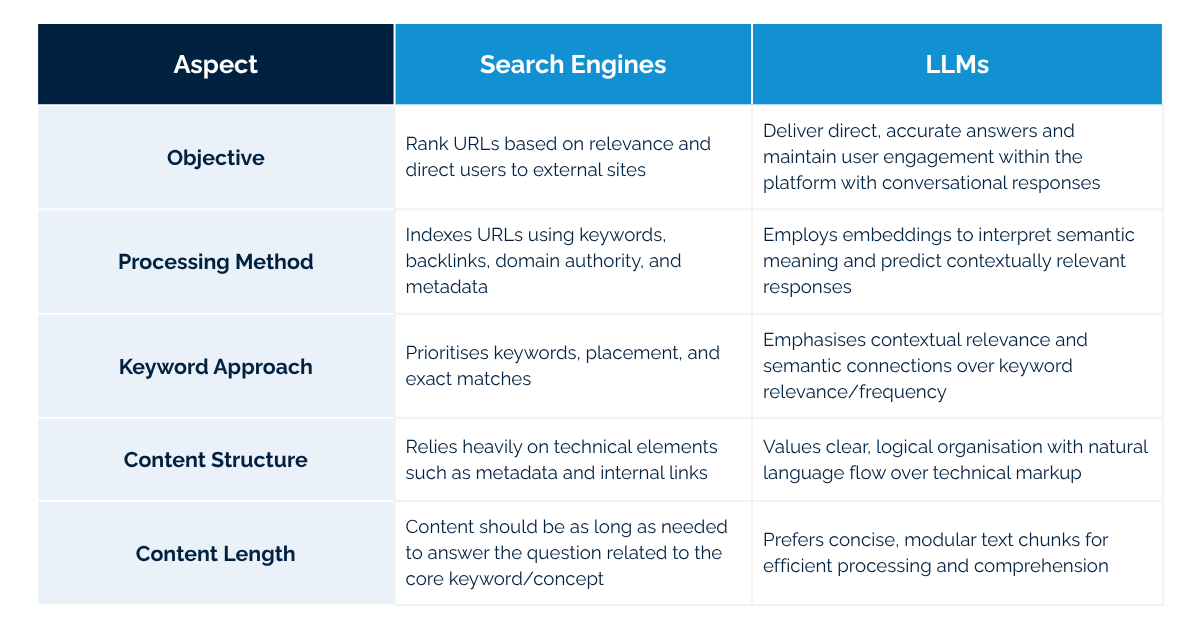
When comparing Large Language Models (LLMs) to traditional SEO, the core difference lies in how content is surfaced and consumed. Traditional SEO focuses on optimising web content to rank higher in search engine results pages (SERPs), where users enter keyword-based queries and receive a list of links optimised to attract clicks.
SEO success depends on visibility, backlinks, and algorithm alignment. In contrast, LLMs bypass this ranking system by directly generating answers to user queries based on their understanding of language and context, not on keyword matching or metadata. As a result, LLMs offer instant, conversational responses without requiring users to sift through links or click on websites.
However, traditional SEO still can play a crucial role in Retrieval-Augmented Generation (RAG), where an LLM retrieves relevant, indexed documents (often SEO-optimised) from a search index or knowledge graph to ground its responses in real-time, ensuring accuracy and freshness. While RAG offers a hybrid approach that combines the depth of search with the fluency of LLMs, it is computationally expensive and tends to be used only when the prompt or query is deserving.
Shared Principles
Blue Array leverages SEO best practices that align with Generative Engine Optimisation (GEO):
- Content Structure: Use headers, bullet points, and tables to enhance readability and AI comprehension.
- E-E-A-T Alignment: Ensure content reflects Experience, Expertise, Authoritativeness, and Trustworthiness to build credibility.
Blue Array’s C-L-E-A-R Framework
Our C-L-E-A-R framework is designed to create content that resonates with human readers, search engines and LLMs. Below, we outline each component with actionable strategies.
C – Clarity: Writing with Precision
Clear, unambiguous content ensures LLMs accurately interpret and reference your brand. Vague or jargon-heavy text can lead to misinterpretation, reducing your brand’s visibility in AI outputs.
Strategies:
- Use simple, direct language, avoiding industry jargon unless clearly defined.
- Specify details such as dates, names, and quantities (e.g., “Blue Array’s 2025 SEO Report” instead of “our recent report”).
- Avoid pronouns without clear antecedents (e.g., write “Blue Array’s analytics tool” instead of “our tool”).
- Include concise summaries at the start of sections to aid LLM retrieval.
Example:
Instead of: “Our tool improved performance last month.”
Write: “Blue Array’s SEO Analytics Tool increased click-through rates by 15% in March 2025.”
L – Logic: Structuring for Comprehension
Logical content organisation helps LLMs connect concepts, strengthening your brand’s presence in AI recommendations. Disorganised content risks being overlooked or misrepresented.
Content design:
- Organise content with clear headings, subheadings, and a logical flow.
- Break content into short, focused paragraphs, each addressing a single idea.
- Use bullet points or numbered lists to present complex information.
- Incorporate conversational language to align with LLM response patterns.
- Keep paragraphs under 100 words to fit within LLM context windows.
- Ensure each section is self-contained to maintain meaning when processed independently.
Structured Data:
- Use tables for comparisons or data-driven insights.
- Implement JSON-LD schema for FAQs, products, or events to enhance context.
E – Expertise: Providing In-Depth Context
LLMs thrive on comprehensive, context-rich content. Blue Array recommends including detailed explanations and background information to deepen AI understanding, even if it exceeds typical human consumption.
Strategies:
- Add FAQs or glossaries to clarify niche topics.
- Include historical context or industry trends to enrich content (e.g., “Blue Array’s 20-year legacy in SEO informs our LLM strategies”).
- Structure in-depth content in digestible chunks to maintain accessibility.
Example FAQ:
Q: How does Blue Array optimise for LLMs?
A: We use the C-L-E-A-R framework to create clear, structured, and credible content, ensuring LLMs accurately interpret and recommend our clients’ brands.
A – Authority: Establishing Credibility
Content must adhere to E-E-A-T principles to gain trust from both LLMs and human readers. Credible content reduces misinformation risks and enhances AI output quality.
Strategies:
- Cite reputable sources for all claims (e.g., “Source: Blue Array’s 2025 SEO Trends Report”).
- Regularly update content to reflect current data and trends.
- Highlight author credentials or organisational expertise (e.g., “Written by Blue Array’s Head of SEO, Mike Stepney, with 15 years of experience”).
R – Repetition: Reinforcing Key Messages
LLMs learn through pattern recognition. Blue Array advocates for consistent messaging across diverse, credible sources to reinforce brand associations without resorting to spammy tactics.
Strategies:
- Leverage Digital PR on authoritative third-party sites.
- Distribute content on-site and across social media.
- Engage in authentic discussion on UGC sites (such as Reddit).
- Use reputation management tools to monitor brand mentions.
- Respond to reviews across all review platforms (don’t just focus on one).
- Rephrase core messages naturally to avoid duplication (e.g., “Blue Array enhances SEO performance” vs. “Blue Array boosts organic search visibility”).
- Use varied formats, such as articles, images, and videos, including short form video, to reinforce concepts.
- Maintain authenticity by writing for humans, not just AI.
Practical Implementation
To implement the C-L-E-A-R framework, Blue Array recommends the following steps:
- Audit Existing Content: Assess current content for clarity, structure, and E-E-A-T compliance.
- Develop Content Templates: Create reusable templates with clear headings, chunked text, and structured data.
- Leverage Analytics: Use GEO tools (such as Evertune AI) to track LLM visibility improvements and refine strategies.
- Update Regularly: Schedule quarterly reviews to ensure content remains accurate and relevant.

Conclusion
Blue Array’s C-L-E-A-R framework empowers brands to excel in AI-driven ecosystems while maintaining SEO excellence. By prioritising clarity, logical structure, expertise, authority, and strategic repetition, we ensure your content is understood, retained, and confidently referenced by LLMs. Partner with Blue Array to future-proof your content strategy and establish your brand as a trusted authority in the age of AI.
Want to analyse your content against Blue Array’s C-L-E-A-R framework? You can with our C-L-E-A-R tool powered by ChatGPT.